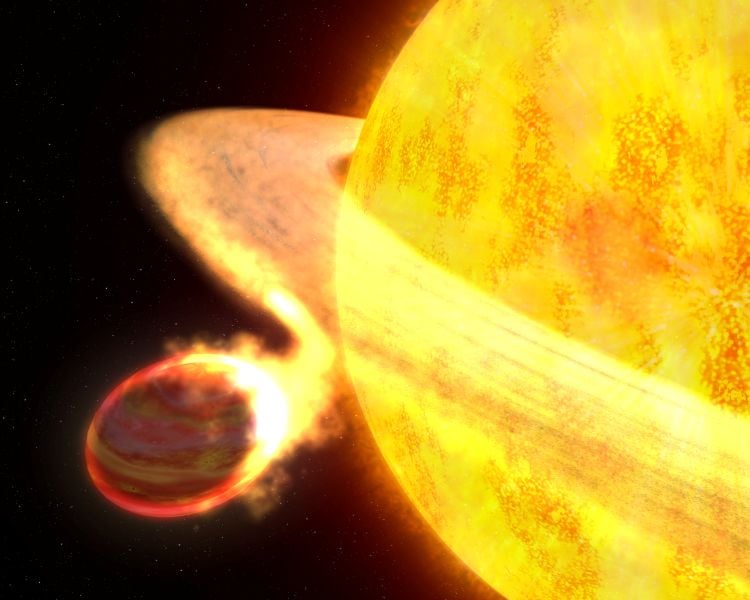
Understanding atmospheric escape in exoplanets gives us valuable clues about planetary evolution. A recent study, published in The Astronomical Journal, explores how gas giants orbiting F-type stars are losing their atmospheres. F-type stars are larger and much hotter than our Sun. When gas giants orbit too closely to these powerful stars, intense stellar radiation and heat can strip away their atmospheres over time.
Why Does Atmospheric Escape Matter?
Atmospheric escape is a key factor in determining a planet’s long-term habitability and structure. This process occurs when the upper layers of a planet’s atmosphere heat up so much that the gas molecules gain enough energy to escape into space. In the case of gas giants around F-type stars, the intense heat and radiation from these stars accelerate the loss of atmospheric gases. Over time, this can dramatically change the planet’s composition and even shrink its size.
Implications for Exoplanet Research
These findings help scientists understand which types of exoplanets might survive close to such powerful stars. Studying these extreme planetary systems sheds light on the diversity of planets in our galaxy and helps refine our search for worlds that might support life. As telescopes and detection methods improve, researchers will continue to uncover new insights about the fate of exoplanets orbiting different types of stars.
Sources:
Surveying Atmospheric Escape from Gas Giants Orbiting F-Type Stars