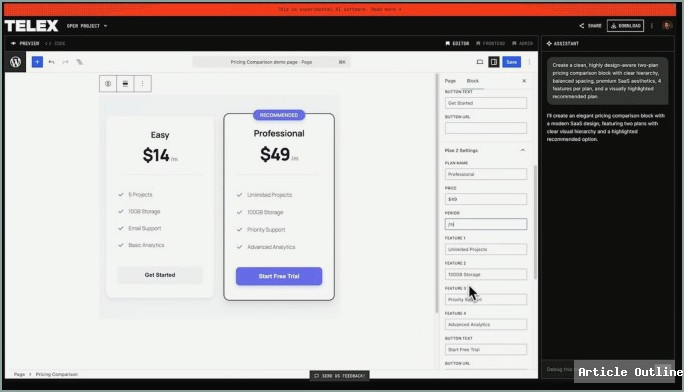
WordPress just gave us a glimpse into the future of website creation with its experimental AI tool, Telex. If you think this is just another tech demo, think again—Telex has already been used in the wild to build real, interactive features that previously would have cost you a small fortune in custom development. Let’s break down why this matters for anyone who builds, runs, or relies on websites in 2025 and beyond.

Why This Matters
- Telex dramatically lowers the barrier to custom site features—think price calculators, real-time store data, interactive carousels, and more, all generated by AI in seconds.
- The cost and speed transformation is jaw-dropping. According to Automattic CEO Matt Mullenweg, what once cost thousands to tens of thousands and took weeks or months now takes minutes and pennies.
- WordPress is positioning itself at the heart of AI-powered publishing, not just by integrating Telex but also by opening up its architecture for other AI systems to plug in seamlessly.
What Most People Miss
- Telex isn’t just about code generation—it’s about democratizing access to advanced web features. Small businesses and indie creators can now compete with bigger players without a massive dev budget.
- It’s also a bridge to the broader AI ecosystem: WordPress is building APIs and adapters (Abilities API, MCP adapter) that let AI agents from platforms like Claude and Copilot directly manipulate and enhance WordPress sites. This is bigger than one tool; it’s a platform shift.
- Experiments are already happening at scale: Developers like Nick Hamze and Tammie Lister are pushing the limits, creating daily AI-generated blocks — from ASCII Tetris games to Halloween trick-or-treat widgets.
Key Takeaways
- AI is now a practical part of the WordPress workflow. From code refactoring to automating site tasks using tools like Cursor and Claude Code, developers are already integrating AI agents into daily routines.
- Benchmarks are coming in 2026: WordPress will introduce test suites so AI models can be evaluated on real-world content management tasks, making the ecosystem even more robust and future-proof.
- The pace of innovation is accelerating: What’s experimental today could be mainstream tomorrow. If you’re in web development, marketing, or content, you can’t afford to ignore these shifts.
Industry Context: How Telex Compares
- Competing with AI-first platforms: While Wix and Squarespace have dabbled with AI assistants, Telex’s integration with Gutenberg blocks and open APIs puts it miles ahead in customizability and developer control.
- Platform lock-in risk drops: By embracing the MCP standard, WordPress ensures you’re not stuck with just one AI vendor, but can swap and experiment with the latest tools.
- Related trends: No-code and low-code solutions are booming, but Telex blurs the line, offering power without complexity.
Expert Commentary
“It’s kind of insane. Things that used to take entire teams and hefty budgets can now be done in a browser for pennies,” — Matt Mullenweg, WordPress Cofounder & Automattic CEO
Action Steps & Practical Implications
- If you run a WordPress site, start exploring Telex-generated blocks—you could automate or enhance features that once seemed out of reach.
- Follow WordPress’s AI initiatives—the upcoming Abilities API and MCP adapter will open new integration possibilities with leading AI agents.
- Stay alert for the 2026 AI benchmark release—this will be a game-changer for evaluating AI tools before deploying them on your site.
The Bottom Line
WordPress’s Telex is not just an experiment—it’s a signal that AI-driven site building isn’t the future. It’s the present. Whether you’re a developer, entrepreneur, or content creator, now is the time to pay attention and experiment. This is how the next wave of the web will be built—faster, smarter, and more accessible than ever.
Sources:
- TechCrunch: WordPress’s vibe-coding experiment, Telex, has already been put to real-world use
- WordPress: State of the Word 2025
- Telex Project
- Blocktober Fun Experiments with Telex
- TechCrunch: WordPress shows off Telex